
Accepting Payments From High-Risk Countries: A Guide for Businesses
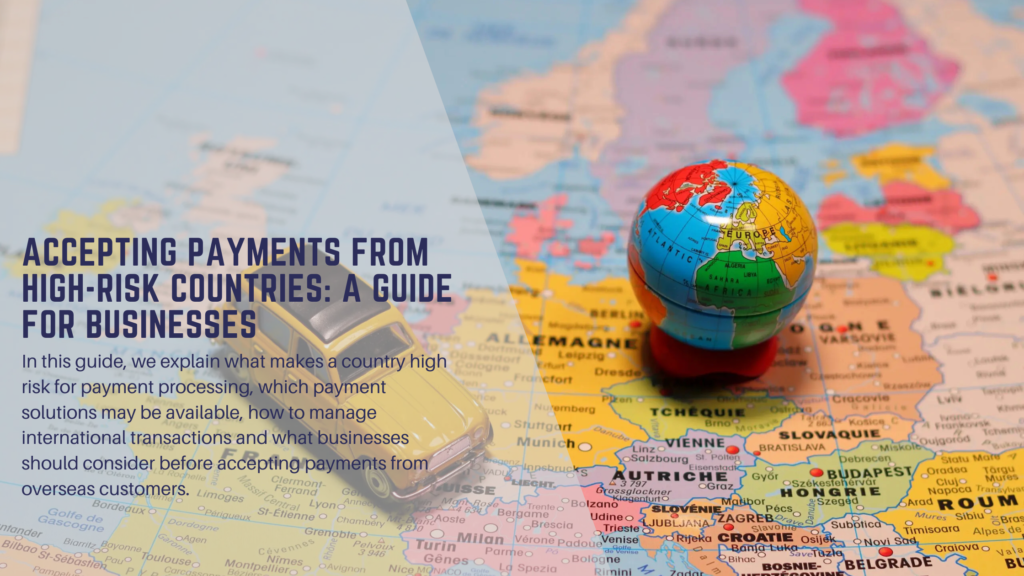
Accepting payments from international customers can open up new opportunities for businesses, but it can also create challenges when customers are based in countries that payment providers consider high risk.
Some businesses find that their existing payment provider does not support certain countries. Others experience declined transactions, additional compliance checks, higher processing fees or difficulties opening a merchant account.
For businesses selling internationally, these restrictions can make it harder to reach new customers and expand into overseas markets.
The good news is that accepting payments from high-risk countries may be possible with the right payment infrastructure and a provider that supports your business model and target markets.
In this guide, we explain what makes a country high risk for payment processing, which payment solutions may be available, how to manage international transactions and what businesses should consider before accepting payments from overseas customers.
What Are High-Risk Countries for Payment Processing?
A country may be considered high risk by a payment provider, acquiring bank or financial institution for several reasons.
These can include elevated fraud levels, chargeback activity, money laundering concerns, financial sanctions, limited banking infrastructure or restrictions affecting cross-border transactions.
However, a country being described as high risk does not automatically mean that all payments involving that country are prohibited.
Payment providers assess different types of risk, and their policies can vary.
For example, a provider might restrict payments from a particular country because of its internal risk policy, even when a transaction is not prohibited by law.
In other cases, financial sanctions or other legal restrictions may prevent certain transactions from being processed.
Businesses need to understand the difference before choosing a payment solution.
Why Do Payment Providers Restrict Certain Countries?
Payment providers and acquiring banks must assess the risks associated with the businesses, customers and transactions they support.
Several factors can influence whether a country is supported.
1. Fraud and Chargeback Risk
Some markets may present higher levels of payment fraud or disputed transactions.
For card payments, chargebacks can create additional costs and operational work for merchants.
Providers may respond by applying additional monitoring, restricting particular transaction types or declining payments from certain locations.
2. Anti-Money Laundering Requirements
Financial institutions must consider money laundering and terrorist financing risks when processing international payments.
The Financial Action Task Force (FATF) publishes information on jurisdictions with strategic deficiencies in their anti-money laundering and counter-terrorist financing systems. Depending on the jurisdiction and applicable rules, this may lead to enhanced due diligence or other restrictions. <Link url=”https://www.fatf-gafi.org/en/countries/black-and-grey-lists.html” title=”See the FATF’s current country lists.” />
3. Financial Sanctions
Sanctions can restrict dealings with particular countries, entities or individuals.
Businesses must establish whether a proposed transaction is permitted under the laws and sanctions regimes that apply to them and their payment providers.
Using a different payment gateway or merchant account does not remove those obligations.
4. Limited Banking Infrastructure
Some countries have fewer international banking connections or limited support for particular currencies and payment methods.
This can make settlements slower, increase costs or limit the available payment routes.
5. Provider Risk Policies
Payment providers do not all support the same countries or industries.
One provider may accept transactions from a market that another provider excludes.
This is why businesses should confirm country coverage before applying for a merchant account or integrating a payment gateway.
Can Businesses Accept Payments From High-Risk Countries?
In some cases, yes.
Whether a business can accept payments depends on the countries involved, the type of transaction, the merchant’s industry, the relevant laws and the payment provider’s policies.
A specialist payment provider may be able to identify suitable acquiring or payment options for eligible businesses that cannot use a standard ecommerce solution.
However, there is no universal payment solution that supports every country or business model.
Before accepting payments from a new market, businesses should check:
- Whether the customer’s country is supported
- Whether the transaction is legally permitted
- Whether the business’s industry is accepted
- Which currencies and payment methods are available
- Whether additional verification is required
- How settlements and refunds will work
- Whether any sanctions or other restrictions apply
Getting these details right before launch can help avoid failed transactions and unnecessary account problems later.
Best Payment Solutions for High-Risk Countries
The most suitable payment method depends on the customer’s location, the merchant’s business model and the payment infrastructure available in the market.
1. High-Risk Merchant Accounts
A high-risk merchant account may be suitable for businesses operating in industries that mainstream acquiring banks are reluctant to support.
These can include certain cryptocurrency businesses, online gambling companies, adult businesses, subscription services and other sectors with elevated processing risks.
A specialist merchant account provider can assess the business and determine whether an appropriate acquiring option is available for its target markets.
However, a high-risk merchant account does not automatically provide access to every country.
Country coverage must be confirmed separately.
2. International Payment Gateways
An international payment gateway connects a business’s website or platform with the payment processing infrastructure used to accept transactions.
Depending on the provider, a gateway may support multiple currencies, card payments, alternative payment methods and transactions from different regions.
Businesses should check which countries the gateway supports for both the merchant and the customer.
These are not always the same thing.
3. Local Payment Methods
Local payment methods can help businesses serve customers who prefer not to use international cards.
Depending on the market, options may include local bank transfers, domestic payment schemes, digital wallets and other regional payment services.
Local methods can improve convenience, but availability depends on the country and provider.
Businesses should also consider whether the method supports refunds, recurring payments and withdrawals where these are relevant.
4. Open Banking and Bank Payments
Open Banking and other bank payment solutions can provide alternatives to card processing in supported markets.
Potential advantages include direct bank connectivity, strong customer authentication and different transaction cost structures.
However, Open Banking availability varies by country and provider. A solution designed for one market may not support payments from customers elsewhere.
Businesses should check the supported countries, currencies, transaction types and settlement arrangements before relying on this option.
5. Multi-Currency Payment Processing
If your business sells internationally, accepting and settling payments in different currencies may be important.
Multi-currency payment processing can help businesses accept payments in supported currencies and manage settlement arrangements.
Before choosing a provider, check:
- Which currencies can be accepted
- Which currencies can be settled
- Currency conversion fees
- Settlement times
- Refund and chargeback handling
- Whether local acquiring is available
Accepting a payment in a customer’s currency does not necessarily mean that the business can settle funds in that same currency.
6. Cryptocurrency Payment Solutions
Some businesses explore cryptocurrency payment solutions when serving international customers.
Availability depends on the business model, supported jurisdictions, provider policies and applicable regulations.
Businesses should assess the legal position, customer verification requirements, transaction monitoring, wallet screening, conversion costs and settlement arrangements.
Cryptocurrency should not be used to bypass financial sanctions or other restrictions.
How to Choose a Payment Provider for High-Risk Countries
Finding a provider that supports international payments requires more than comparing transaction fees.
The following factors should be considered before making a decision.
Check Country Coverage First
Ask the provider for its current list of supported countries.
Be specific about where your customers are located, where your company is registered and where you want to receive settlements.
This can help establish whether the provider is suitable before you spend time on an application.
Confirm Your Industry Is Supported
A provider may support a particular country but decline businesses operating in certain sectors.
Explain your business model clearly and confirm that the provider can support your industry.
This is particularly important for businesses in regulated or higher-risk sectors.
Compare Payment Methods
Look at the payment methods your customers actually use.
Depending on your market, you may need international cards, local payment methods, bank transfers, digital wallets or other payment options.
Choose methods that suit your customers rather than simply selecting the provider with the longest list.
Understand the Fees
International payments can involve several charges.
Ask for a breakdown of:
- Transaction fees
- Cross-border fees
- Currency conversion
- Gateway fees
- Refund fees
- Chargeback fees
- Settlement fees
- Monthly fees
- Reserve requirements
The cheapest headline transaction rate does not always result in the lowest overall processing cost.
Check Settlement Times
Confirm how frequently funds are settled and whether settlement is available in your preferred currency.
Ask whether additional reviews, reserves or restrictions could affect access to funds.
Review Fraud Prevention
A suitable provider should have risk controls appropriate to the business and transaction types involved.
Depending on the setup, these may include fraud screening, transaction monitoring, authentication tools and chargeback management.
Confirm Compliance Requirements
Make sure you understand the provider’s verification and compliance requirements before accepting payments.
Depending on the transaction and jurisdiction, additional information may be required about the business, its customers or the source of funds.
How to Reduce Declined Payments From High-Risk Countries
Not every declined international payment is caused by the customer’s bank balance or card details.
Transactions may fail because of issuer restrictions, unsupported countries, currency limitations, fraud screening or provider rules.
Businesses can take several steps to improve payment performance.
1. Check Supported Countries Before Launch
Do not assume that a provider supports a market simply because it accepts international payments.
Confirm the exact countries and transaction types covered.
2. Offer Relevant Payment Methods
Customers may be more likely to complete a purchase when they can use a familiar payment method.
Where appropriate, offer alternative methods supported in your target markets.
3. Use Clear Currency and Pricing Information
Make it clear which currency the customer will be charged in and whether any additional conversion costs may apply.
Unexpected charges can create confusion and disputes.
4. Monitor Decline Reasons
Review transaction reports to identify patterns.
For example, repeated declines from one market may indicate a country restriction, a problem with a particular payment route or an issue with currency support.
Use the information provided by your payment provider to investigate the cause.
5. Keep Business Information Accurate
Ensure that your website, merchant account application and payment provider records accurately describe your business.
Changes to your products, services, countries served or transaction volumes should be communicated when required by your provider.
6. Avoid Unnecessary Payment Friction
A checkout that is difficult to use can cause customers to abandon their purchases.
Make the process clear, mobile-friendly and appropriate for the payment methods available in each market.
Payment optimisation should always remain within the provider’s rules and applicable law.
Compliance Considerations When Accepting Payments Internationally
International payment processing can involve several legal and regulatory requirements.
The relevant obligations depend on the countries involved, the business’s activities and the payment services being used.
Financial Sanctions
Businesses should screen transactions and relevant parties where required, and ensure that payments are not processed in breach of applicable sanctions.
The UK government’s <Link url=”https://www.gov.uk/guidance/uk-financial-sanctions-guidance” title=”financial sanctions guidance” /> explains the framework businesses should consult when assessing UK sanctions obligations.
Anti-Money Laundering Checks
Where applicable, businesses and their payment partners must meet relevant anti-money laundering requirements.
This may involve customer due diligence, beneficial ownership checks, transaction monitoring and additional scrutiny of certain relationships or transactions.
Customer Verification
Depending on the business and payment service, providers may require information to verify customers, directors, beneficial owners or the origin of funds.
Having relevant documentation ready can help reduce avoidable delays.
Data Protection
Businesses collecting customer information must consider the data protection laws that apply to their activities and the locations of their customers.
Payment integrations should also be configured to protect sensitive payment and personal information.
Country-Specific Rules
A transaction being supported by a payment provider does not necessarily mean that the underlying sale is lawful in every market.
Businesses should check any local restrictions affecting their products, services and customers.
What Is the Difference Between a High-Risk Country and a High-Risk Business?
These terms describe different types of risk.
A high-risk country is a market that may present additional geographic, regulatory, financial crime or payment processing risks.
A high-risk business is a company that a payment provider considers to have a higher processing risk because of factors such as its industry, chargeback profile, business model or transaction patterns.
A business can be considered high risk even when it serves customers in countries that are not classified as high risk.
Likewise, a business in a relatively low-risk industry may face additional restrictions when accepting transactions connected to a particular jurisdiction.
Payment providers assess these factors separately, although they may influence one another.
Why High-Risk Payment Processing May Cost More
Businesses accepting international payments may face higher costs than those processing domestic transactions.
The final price depends on the payment method, provider, acquiring arrangement, transaction profile and countries involved.
Potential costs include:
- Higher transaction fees
- Cross-border processing charges
- Currency conversion fees
- Chargeback fees
- Additional compliance costs
- Rolling reserves or other settlement arrangements
Some providers may also impose minimum monthly charges or transaction limits.
Before signing an agreement, ask for a complete breakdown of costs and clarify how fees or reserves could change as your business grows.
How Merchant Connect Can Help
Merchant Connect helps businesses explore merchant account and payment processing options suited to their business model and target markets.
For companies that need to accept international payments, the available options may include high-risk merchant accounts, international payment gateways, multi-currency processing and alternative payment methods.
The right solution depends on factors such as:
- Your industry
- Company registration country
- Customer locations
- Expected transaction volumes
- Average transaction value
- Required currencies
- Existing processing history
- Compliance requirements
Merchant Connect can help you explore suitable payment options and understand which providers may be able to support your requirements.
Support and availability depend on the business, transaction type, jurisdiction and provider underwriting criteria. Not every country or business model will be eligible.
If your current payment provider does not support your target markets, it is worth reviewing your requirements before applying for another merchant account.
Frequently Asked Questions
Can I accept payments from high-risk countries?
Potentially, yes. Availability depends on the country, transaction, business model, applicable laws and payment provider’s policies. Some markets or transactions may be restricted or prohibited.
What is the best payment gateway for high-risk countries?
There is no single gateway that supports every country or industry. Compare country coverage, supported payment methods, currencies, fees, settlement arrangements and compliance requirements.
Can a high-risk merchant account accept international payments?
Some high-risk merchant accounts support international transactions, but coverage varies. Confirm the supported countries, currencies and transaction types before applying.
Why are payments from certain countries declined?
Transactions can be declined because of issuer restrictions, unsupported markets, fraud screening, currency limitations, provider policies or legal restrictions.
Can I accept payments in multiple currencies?
Some payment providers support multiple currencies. Check which currencies can be accepted and whether funds can be settled in your preferred currency.
Do high-risk international payments cost more?
They can. Costs may include cross-border fees, currency conversion, higher transaction charges, chargeback fees and reserve requirements. Pricing varies between providers.
Can I use cryptocurrency to accept payments from restricted countries?
Cryptocurrency does not remove sanctions or other legal restrictions. Businesses must assess the applicable laws, provider policies and compliance requirements before accepting cryptocurrency transactions.
How can I find a payment provider for my target countries?
Prepare a list of your customer markets, company registration details, industry, expected transaction volumes and required currencies. Use these details to identify providers that support your business and the relevant countries.
Conclusion
Accepting payments from high-risk countries can create additional challenges, but the right payment setup may help eligible businesses reach more international customers.
The important thing is to understand the risks and restrictions before choosing a provider.
Start by checking country coverage, payment methods, fees, currencies, settlement times and compliance requirements. Then compare providers based on how well they support your specific business model.
The right international payment solution should help your business accept permitted transactions reliably without creating unnecessary operational or compliance risks.
If you need help exploring payment options for international or high-risk markets, Merchant Connect can help you identify potential solutions based on your requirements.
Contact Merchant Connect to discuss your business and international payment processing needs.
Related articles
Fast Approval Merchant Accounts for High-Risk Businesses
Getting a merchant account can be difficult for businesses that operate in industries considered high risk. Traditional banks and payment providers may take longer…
Read article
Payment Gateway vs Merchant Account: What’s the Difference?
If you’re setting up payment processing for an online casino, sportsbook, betting website or other iGaming business, you’ll often come across two terms: payment…
Read article
Accepting Payments From High-Risk Countries
For businesses selling internationally, expanding into higher-risk markets can create significant growth opportunities. However, accepting payments from high-risk countries can also create additional challenges…
Read article