October 4, 2026

 Written by: Merchant Connect UK
Getting a merchant account can be difficult for businesses that operate in industries considered high risk.
Traditional banks and payment providers may take longer to review applications, ask for additional documentation or decline businesses because of their industry, chargeback exposure, business model or international transactions.
For a business that needs to start taking card payments quickly, waiting weeks for a decision can be a serious problem.
This is why many businesses look for fast approval merchant accounts for high-risk businesses.
A fast approval does not mean skipping underwriting or compliance checks. Instead, it usually means working with a payment provider or specialist that understands high-risk industries and can match the business with an appropriate acquiring solution.
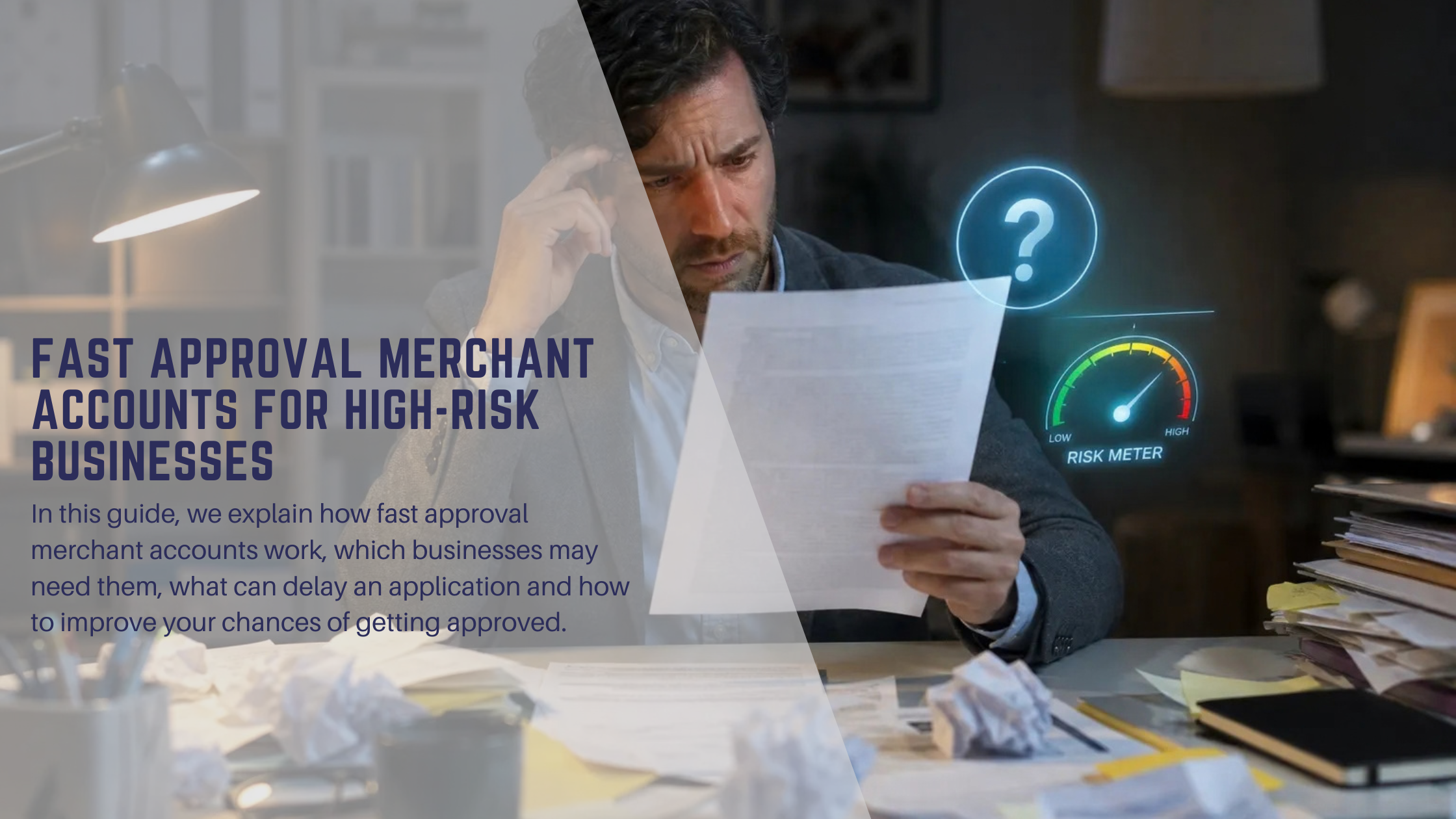
In this guide, we explain how fast approval merchant accounts work, which businesses may need them, what can delay an application and how to improve your chances of getting approved.
A fast approval merchant account is a merchant account designed to get a business through the application and underwriting process as efficiently as possible.
The exact approval time varies depending on the business, industry, country, processing history and acquiring bank.
A straightforward application with all the required information may be reviewed much faster than an application with missing documents or an unclear business model.
For high-risk businesses, the process can involve additional checks around:
The objective is not simply to get an account approved quickly.
It is to find a suitable merchant account that can continue processing payments reliably after approval.
Some businesses are considered higher risk because of the nature of their products, services or payment activity.
Factors can include high chargeback rates, recurring billing, international transactions, regulatory requirements or industries that are more closely monitored by financial institutions.
Examples can include:
Being classified as high risk does not automatically mean a business cannot accept card payments.
It generally means that the business may need a payment provider and acquiring bank that are comfortable underwriting its particular risk profile.
There is no universal approval time for high-risk merchant accounts.
Some applications can move relatively quickly when the business is suitable for the acquiring partner and the application is complete.
Other applications can take longer where additional underwriting, compliance checks or documentation are required.
The biggest factors affecting approval speed include:
Missing documents can cause unnecessary delays.
The provider needs to understand exactly what the business sells, who its customers are and how payments will work.
An existing processing history can help an underwriter understand transaction volumes, chargebacks and payment performance.
The website may need to clearly display important information such as terms and conditions, refund policies, privacy information, contact details and product or service information.
Different acquiring banks have different risk appetites.
Applying to an unsuitable provider can result in a decline before the application reaches an acquirer that actually supports the business model.
The exact requirements vary by provider and business type, but high-risk merchant account applications commonly require information such as:
For regulated or particularly sensitive industries, additional information may be required.
Providing the information upfront can help reduce unnecessary back-and-forth during underwriting.
A fast application can still be declined if the business does not meet the requirements of the acquiring provider.
Common reasons can include:
Some acquirers simply do not accept certain industries.
This does not necessarily mean the business cannot obtain payment processing elsewhere.
It may mean that a different acquiring relationship is required.
An incomplete website can make it difficult for an underwriter to understand what the business sells.
Missing policies, unclear pricing or limited product information can create additional questions.
If a new business expects to process significantly more volume than its current size or history suggests, the provider may require further information.
High chargeback levels, excessive refunds or previous account termination can make approval more difficult.
High-risk industries often require greater scrutiny around customers, transactions and financial crime controls.
One of the most common mistakes is submitting applications to payment providers without first checking whether they support the business model.
This can lead to unnecessary declines and wasted time.
If speed is important, preparation matters.
Have your company documents, identification, bank statements and processing history ready.
Your website should clearly explain:
Do not attempt to hide the nature of your business or describe a high-risk activity as something else.
The acquiring bank needs accurate information to assess the account correctly.
Be realistic about:
A straightforward explanation of how customers find you, what they purchase and how you fulfil orders can make underwriting easier.
A specialist high-risk payment partner can help identify suitable acquiring options before an application is submitted.
This can be particularly useful if the business has already been declined by a mainstream provider.
This is an important distinction.
There is no legitimate merchant account solution that can guarantee approval for every business.
Every acquiring bank and payment provider has its own underwriting criteria.
A business may also be declined because of factors outside the control of the merchant account provider.
Therefore, businesses should be cautious about providers promising:
A better approach is to find a provider that understands the business and can identify suitable acquiring options.
UK businesses operating in high-risk industries may have additional considerations when choosing a payment solution.
The right setup can depend on:
For businesses operating in regulated sectors, payment processing also needs to fit within the relevant regulatory framework.
For example, UK gambling operators must comply with applicable Gambling Commission licence conditions and codes of practice. The Gambling Commission’s current payment condition requires remote gambling licensees accepting payment services in Great Britain to use a qualifying payment service provider.
The Commission’s 2026 risk assessment also highlights the changing money-laundering and terrorist-financing risks facing the gambling sector, including risks associated with new payment technologies.
This is why regulated and high-risk businesses should treat compliance as part of their payment strategy rather than something to deal with after approval.
International businesses often need more than a UK merchant account.
If customers are located across different countries, the business may need:
The right setup depends on the countries being served and the business’s risk profile.
For some businesses, using more than one payment provider can also provide additional payment resilience.
Approval speed is important, but it should not be the only consideration.
Check whether the solution supports the card schemes and transaction types your customers need.
Useful for businesses selling internationally.
The merchant account should work with your website, ecommerce platform or existing payment infrastructure.
Look for appropriate fraud screening and transaction monitoring.
High-risk businesses should understand how chargebacks are monitored and managed.
If you sell internationally, check whether the provider can support the relevant markets.
Depending on your industry and customer base, you may also require methods such as bank payments, Open Banking, e-wallets or other alternative payment methods.
Understand where funds will be settled, in which currency and how frequently.
Getting approved quickly is useful.
But getting an account that lasts is even more important.
A business that gets approved quickly but later experiences excessive chargebacks, unexplained account restrictions or termination has not necessarily found a good payment solution.
This is why businesses should consider the complete payment relationship.
Before choosing a provider, ask:
The objective should be fast approval and sustainable payment processing.
Merchant Connect helps businesses in high-risk industries explore suitable merchant account and payment processing solutions.
Rather than taking a one-size-fits-all approach, the business model, industry, target market and processing requirements can be considered when looking for an appropriate payment solution.
Solutions can include:
Merchant Connect works with businesses across sectors where traditional payment providers may not always be suitable.
The aim is to help businesses identify a payment setup that fits their requirements rather than simply submitting applications to providers that may not support their industry.
Fast approval merchant accounts can be particularly useful for businesses that:
For businesses already processing payments, it can also be useful to have an alternative payment solution available before an existing account becomes a problem.
A fast approval merchant account is a merchant account application designed to move through underwriting and onboarding efficiently. Approval times vary depending on the business, industry, documents and acquiring bank.
Yes, some high-risk businesses can receive relatively quick decisions when they are matched with a suitable provider and submit complete documentation. However, no provider can legitimately guarantee approval for every business.
Industries commonly considered higher risk can include gambling, cryptocurrency, forex, adult businesses, supplements, subscriptions and certain international or high-chargeback businesses. Risk classification ultimately depends on the provider and the specific business.
There is no fixed timeframe. Some applications can be processed quickly, while others require additional underwriting and documentation. Providing complete and accurate information can help avoid unnecessary delays.
Potentially, yes. A decline from one provider does not necessarily mean every provider will decline the business. The business may need to be matched with an acquiring partner that supports its particular industry and risk profile.
They can. High-risk businesses may face higher processing fees, reserves, minimum monthly fees or other costs because of the additional risk associated with the account.
Yes, specialist payment solutions are available for eligible UK businesses operating in higher-risk industries. The availability of a merchant account depends on the business model, industry, compliance position and acquiring provider.
No. Fast approval refers to the speed of the application and underwriting process. It does not mean that an application will automatically be accepted.
Finding a merchant account can be more complicated when your business operates in a high-risk industry.
However, being classified as high risk does not mean you have to rely on unsuitable payment providers or spend weeks submitting applications to banks that do not support your business model.
A specialist approach can help identify suitable acquiring options, prepare the required documentation and reduce unnecessary delays.
The key is to look beyond fast approval.
The right merchant account should provide a combination of:
Suitable underwriting + reliable processing + competitive pricing + compliance + room to grow.
If you are looking for a fast approval merchant account for a high-risk business, Merchant Connect can help you explore suitable payment processing options based on your business model and requirements.
If you have been declined, are launching a high-risk business or need a new merchant account, contact Merchant Connect to discuss your requirements and available payment solutions.