
Accepting Payments From High-Risk Countries
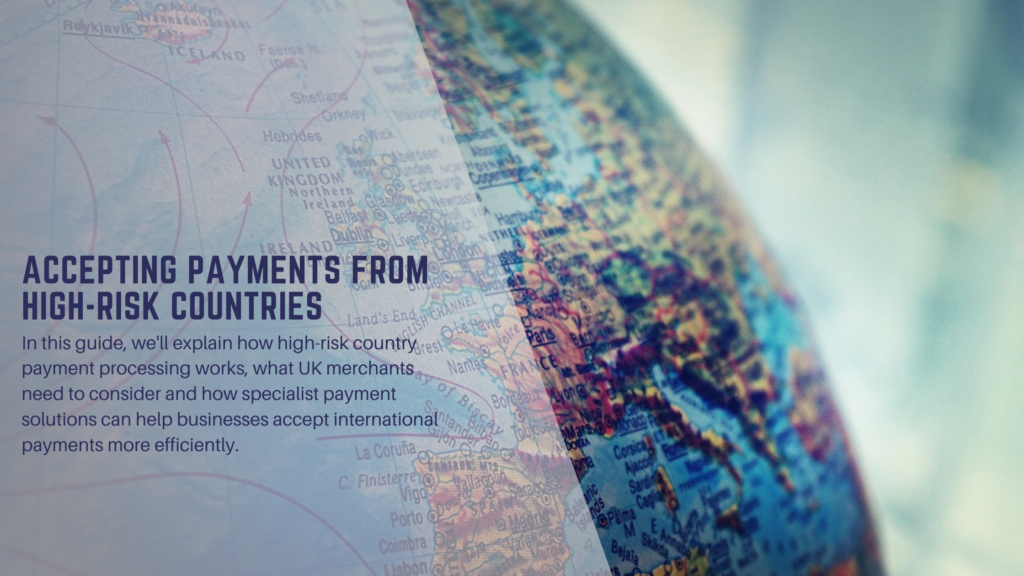
For businesses selling internationally, expanding into higher-risk markets can create significant growth opportunities. However, accepting payments from high-risk countries can also create additional challenges around payment processing, fraud prevention, Anti-Money Laundering (AML), sanctions screening and merchant account approval.
For UK businesses, having the right payment infrastructure is particularly important when customers are located in jurisdictions that payment providers or financial institutions consider higher risk.
This doesn’t necessarily mean that payments from every higher-risk country are prohibited. Instead, merchants and payment providers need to assess the specific customer, transaction, country, business activity and applicable regulatory requirements.
In this guide, we’ll explain how high-risk country payment processing works, what UK merchants need to consider and how specialist payment solutions can help businesses accept international payments more efficiently.
What Is a High-Risk Country?
A high-risk country is generally a jurisdiction that presents additional financial, regulatory, fraud, sanctions or money-laundering risks.
Payment providers may consider factors such as:
- Financial crime exposure
- Sanctions
- Political instability
- Fraud levels
- Regulatory standards
- Banking infrastructure
- AML controls
- Transaction transparency
Importantly, high risk does not automatically mean prohibited.
Payment providers assess countries and transactions using their own risk policies, as well as applicable laws and regulations.
Can UK Businesses Accept Payments From High-Risk Countries?
In some circumstances, yes.
However, the ability to process a transaction depends on several factors, including:
- The customer’s country
- The merchant’s industry
- The payment method
- The customer’s identity
- The source of funds
- Applicable sanctions
- The payment provider’s risk appetite
UK businesses should never assume that a payment can be accepted simply because a particular country isn’t specifically excluded by their payment gateway.
Financial sanctions can prohibit transactions involving designated individuals, organisations or governments, and in some circumstances can restrict financial services involving particular countries. The UK’s sanctions regime is administered by the Office of Financial Sanctions Implementation (OFSI).
Why Are Payments From Higher-Risk Countries More Difficult?
International transactions can create additional challenges for merchants and payment providers.
1. Increased Fraud Risk
Certain markets may present higher levels of card fraud, account takeover or fraudulent transactions.
Payment providers therefore use additional transaction monitoring and risk controls.
2. AML Requirements
Businesses may need stronger customer due diligence when dealing with higher-risk customers or transactions.
The FCA states that firms should take a risk-based approach to customer due diligence and apply enhanced due diligence in higher-risk situations.
3. Sanctions Screening
Merchants need to consider whether customers, beneficial owners, counterparties or other parties involved in a transaction are subject to applicable sanctions.
UK sanctions can apply to transactions involving designated individuals and entities, regardless of where they are located.
4. Payment Provider Restrictions
A payment processor may have its own restricted-country or prohibited-business policies.
This means that even where a transaction may be legally possible, a particular payment provider may decide not to support it.
What Is High-Risk Country Payment Processing?
High-risk country payment processing refers to payment infrastructure designed to help businesses manage transactions involving customers or markets that present increased financial or regulatory risk.
Depending on the merchant and market, solutions can include:
- Card processing
- Bank transfers
- Open Banking
- Alternative payment methods
- Multi-currency payments
- Local payment methods
- Enhanced fraud monitoring
The right combination depends on the countries being targeted and the merchant’s industry.
Key Considerations Before Accepting International Payments
Before expanding into a higher-risk market, merchants should consider several important areas.
1. Country Restrictions
Start by identifying which countries your payment provider supports.
Payment providers often maintain their own lists of:
- Supported countries
- Restricted countries
- Prohibited countries
These lists can change, so merchants should regularly review their provider’s current requirements.
2. Sanctions Screening
Sanctions compliance should be a fundamental part of international payment processing.
UK businesses need to understand whether sanctions apply to:
- Customers
- Companies
- Directors
- Beneficial owners
- Payment recipients
- Financial institutions
- Other counterparties
The FCA recommends that firms maintain systems and controls capable of meeting their financial sanctions obligations, including checking relevant parties against the UK Sanctions List.
3. Customer Verification
Strong KYC procedures can help merchants understand who they are doing business with.
Depending on the business model and risk level, verification may include:
- Name verification
- Date of birth
- Address verification
- Identity documents
- Business verification
- Beneficial ownership checks
Higher-risk situations may require enhanced due diligence.
Accepting Payments From High-Risk Customers
It’s important to distinguish between high-risk countries and high-risk customers.
A customer may present additional risk because of:
- Unusual transaction activity
- Complex ownership
- Unclear source of funds
- High-value transactions
- Geographic connections
- Sanctions exposure
The FCA notes that higher-risk situations can require enhanced due diligence and ongoing monitoring.
Payment Methods for International High-Risk Markets
Choosing the right payment methods can make a significant difference to approval rates and customer experience.
Card Payments
Visa and Mastercard remain important for international eCommerce.
Benefits include:
- Familiarity
- Broad acceptance
- Fast authorisation
- Easy integration
However, card payments can expose merchants to higher fraud and chargeback risks in certain sectors.
Bank Transfers
Bank transfers can be useful for larger transactions and business-to-business payments.
They can provide:
- Higher transaction limits
- Direct account-to-account transfers
- Reduced card chargeback exposure
However, international transfers may involve additional banking checks and settlement times.
Open Banking
Open Banking provides account-to-account payment capabilities in supported markets.
For eligible UK and European transactions, it can provide an alternative to traditional card processing.
Potential advantages include:
- Direct bank payments
- Reduced card dependency
- Faster payment experiences
- Strong customer authentication
The availability of Open Banking varies by country, provider and use case.
Alternative Payment Methods
Local payment methods can be particularly important when expanding internationally.
Depending on the market, these may include:
- Local bank transfers
- Digital wallets
- Account-to-account payments
- Regional payment solutions
Supporting the payment method customers already know can improve checkout conversion.
How to Reduce Payment Risk
Businesses accepting international payments should take a proactive approach to risk management.
Use Transaction Monitoring
Monitor transactions for unusual patterns, unexpected locations and abnormal payment behaviour.
Set Appropriate Transaction Limits
Transaction limits can help control exposure to unusually large or suspicious payments.
Use Fraud Prevention Tools
Modern payment platforms can use:
- 3D Secure
- Device fingerprinting
- Velocity checks
- IP analysis
- Risk scoring
- Automated transaction monitoring
Maintain Strong KYC Procedures
Know who your customers are and understand the nature of their transactions.
Monitor Chargebacks
High chargeback levels can negatively affect your merchant account and may lead to additional scrutiny from acquiring partners.
High-Risk Countries vs Sanctioned Countries
These terms should not be treated as interchangeable.
A high-risk country may simply have a higher level of financial, regulatory or fraud risk.
A sanctioned country or jurisdiction may be subject to specific legal restrictions.
UK sanctions can be geographic, thematic or targeted at specific individuals and entities. The UK Government maintains current sanctions regimes and designations, and the rules can change.
Therefore, merchants should not create a simple list of “countries we can accept” and assume it will remain accurate indefinitely.
Always check the current requirements applicable to the transaction.
Industries That May Need Specialist International Payment Processing
Certain industries are more likely to require specialist payment solutions when accepting international transactions.
These can include:
- iGaming
- Sports betting
- Cryptocurrency
- Forex
- Adult businesses
- Travel
- Subscription services
- Digital goods
- Nutraceuticals
These businesses may already be classified as high risk by banks or acquiring institutions, and adding international transactions can increase the complexity of payment processing.
Why High-Risk Merchants Need the Right Payment Provider
A suitable payment provider should understand both your industry and your target markets.
When comparing providers, consider:
Geographic Coverage
Does the provider support the countries you want to target?
Payment Methods
Can customers pay using the methods they prefer?
Currency Support
Can you process GBP, EUR, USD and other relevant currencies?
Fraud Prevention
What tools are available to identify suspicious transactions?
Settlement
How quickly can you access your funds?
Compliance
Does the provider have appropriate AML, KYC and sanctions controls?
Account Stability
Does the provider have experience working with businesses in your industry?
What Documents May Be Required?
When applying for international high-risk payment processing, providers may request additional information.
This can include:
- Certificate of Incorporation
- Proof of business address
- Director identification
- Beneficial ownership information
- Business bank statements
- Processing statements
- Website information
- AML policies
- KYC procedures
- Licences
- Expected processing volumes
- Target countries
Providing accurate and complete information can help make the underwriting process more efficient.
How to Prepare for International Payment Processing
Before launching in a new market, create a payment and compliance checklist.
Business
- Is the company correctly registered?
- Is the website fully operational?
- Are your terms and conditions available?
Compliance
- Are your KYC procedures appropriate?
- Do you have AML controls?
- Are sanctions checks in place?
Payments
- Which payment methods will you offer?
- Which currencies will you accept?
- Which countries will you target?
Risk
- How will you monitor transactions?
- How will you manage chargebacks?
- What happens when a transaction is flagged?
A clear strategy can help reduce payment problems as you expand.
Why Some Payments May Still Be Declined
Even if a country is supported, an individual transaction can still be declined.
Reasons can include:
- Fraud screening
- Bank restrictions
- Insufficient funds
- Incorrect payment information
- Sanctions concerns
- Customer verification issues
- Merchant risk rules
- Payment provider restrictions
A declined transaction does not necessarily mean that the country itself is prohibited
How Merchant Connect Can Help
At Merchant Connect, we help businesses explore payment solutions for complex and higher-risk industries.
Our solutions can include:
- High-risk merchant accounts
- International payment processing
- Multi-currency payment solutions
- Card processing
- Open Banking
- Alternative payment methods
- Fraud prevention
- Chargeback management
We work with businesses that may have difficulty obtaining suitable payment infrastructure through traditional providers.
The right solution depends on your industry, target countries, transaction profile and compliance requirements.
Final Thoughts
Accepting payments from high-risk countries requires more than simply finding a payment gateway that accepts international cards.
Businesses need to consider country restrictions, sanctions, AML, KYC, fraud prevention, chargebacks, payment methods and the requirements of their acquiring partners.
For UK businesses, compliance should remain a priority. The FCA expects firms to take a risk-based approach to financial crime controls, while OFSI provides guidance on complying with UK financial sanctions.
With the right payment provider and appropriate risk controls, businesses can explore international growth while maintaining a robust payment infrastructure.
If your business needs help finding high-risk payment processing solutions for international customers, Merchant Connect can help you explore suitable options.
Contact Merchant Connect today to discuss your international payment requirements.
Related articles
Fast Approval Merchant Accounts for High-Risk Businesses
Getting a merchant account can be difficult for businesses that operate in industries considered high risk. Traditional banks and payment providers may take longer…
Read article
Payment Gateway vs Merchant Account: What’s the Difference?
If you’re setting up payment processing for an online casino, sportsbook, betting website or other iGaming business, you’ll often come across two terms: payment…
Read article
What Documents Do You Need for a High-Risk Merchant Account?
Applying for a high-risk merchant account can be more involved than applying for a standard merchant account. Payment providers and acquiring banks need to…
Read article